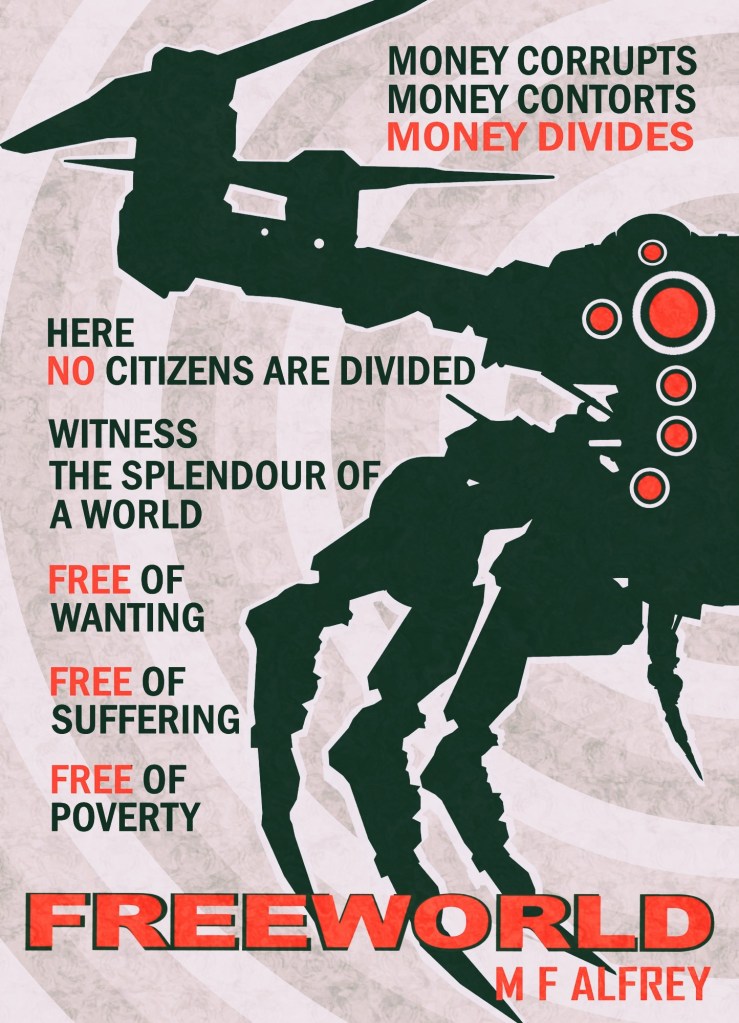
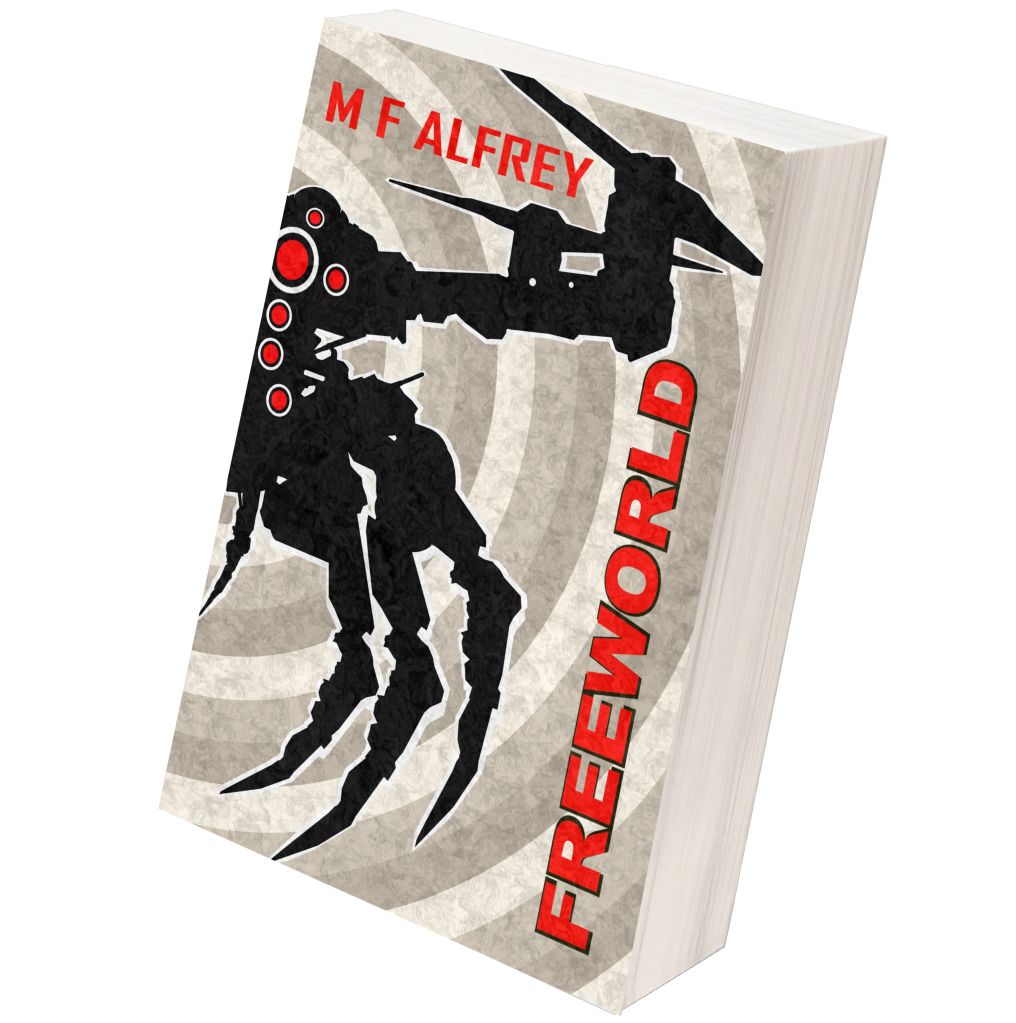
FREEWORLD releases on November 5th, 2026, on Amazon and will be available in eBook and paperback formats, and Kindle Unlimited.
What was the motivation for you when conceiving of Freeworld?
I’ve spent a lot of time abroad, both working and travelling, and have had the opportunity to learn about the history, politics, and culture of a variety of places. I’ve witnessed many ways in which a country could grow and change. Many ways a society could be. The customs, traditions, and innovations. But also, the darker sides.
Freeworld is not a commentary on one particular place or political system. Rather, Freeworld is an amalgamation of countries past, present, and projected. The Country, the setting for the story, could be anywhere, at any time.
Anyway, what I learnt during my traveling experiences got me asking more questions, naturally digging into history, which threw up similar instances of what had got under my skin, the answer to this question “what was the motivation for you when conceiving of Freeworld?” is the systematic disappearing of a culture and people. I don’t need to say much more on the topic, because I think everyone is aware of these things in our past, and present.
Terrible things are still happening. Peoples and cultures are still being persecuted and there are still unscrupulous, powerful people who are directing these operations. My concern is that due to the information overload and fake news that abounds in our world now, these issues simply pass us by in the scroll, perhaps may seem a thing of the past, or even fiction. They are not. They still occur. They are not a distant far away thing even. Not just something that happens in another country. They happen in our own backyard. I mean, the world is our backyard, but these things happen closer to home too.
I worry we’re being blinded by information overload, smoke and mirrors forming a veil behind which atrocities can be conducted without our knowing or, conversely, carried out in plain sight yet ignored as fakery. Another element of life that concerns me, and is the fundamental underpinning of Freeworld, is this concept of free stuff, particularly free apps that harvest our data and potentially do other nefarious things. That coupled with the gamification of certain aspects of our life. They come in many forms but the overall concept is they trivialise a topic or goal, drastically reduce it down to its simplest and ultimately unnourishing form, and encourage a distanced attitude which is leeching into our lives such as manifesting as the phenomenon of perceiving the rest of society as non-player characters, or feeling like one yourself as a result of the dehumanizing effect of such things as social media, and generative AI.
This genre is different to your previous works; have you got any techniques for switching into writing a different genre?
Oh, that’s an easy one: consume the genre itself. I immerse myself in that genre. Some call it reading the market, so there’s a strategic element to it as well. I also want to add something worthwhile to the genre, rather than just rehashing a tale.
Generally speaking, I always write in my genre: science-fiction, fantasy, horror. I approach them as one beast really. It’s just that the sci-fi element may be dialled up more in one story than, say, the horror or the fantasy. There’s horror in Freeworld, but it’s the subtle horror of social control. More insidious. I think that’s scarier to be honest. I not only read, but watch, or in this case rewatch, movies in the genre. Bladerunner (1982), was one of these movies, I also enjoyed Dark City (1998), Logan’s Run (1976), Fahrenheit 541 (1966), Brave New World (1980), 1984 (1984), The Circle (2017), The Matrix Quadrilogy (1999-2021), Equilibrium (2002), etc. Some of those, of course, were originally books, but the movies have their own edge and their own perspective on dystopia. I take a mixed media approach to my research. Current and historical news is a valuable source of inspiration. Sadly, dystopias are not something of pure fiction.
Another thing that helps when I’m writing is music. Those movies I mentioned have great soundtracks, so I listen to them. One of my favourites is Harold Faltermeyer’s soundtrack for The Running Man (1987). I really vibe off that, especially the opening.
Which books have had the biggest influence on you while writing Freeworld?
I mentioned those movies earlier, the ones which were originally books. Various authors deserve a mention. George Orwell, Ray Bradbury, Aldous Huxley too, went through re-reads. I discovered on top of those books, Dave Eggers’s The Circle (2013) which, in my opinion, is much better than the movie. I was pleasantly surprised to find one of my favourite movies was originally a book by a favourite author. The Running Man (1982) by Steven King writing as Richard Bachman. I also delved into dystopian history on my wife’s recommendation which led me to WE (1920-1921) by Yevgeny Zamyatin and The Iron Heel (1908) by Jack London.
In terms of direct content influence, Ray Bradbury’s “hound” from Fahrenheit 541 (1953) was one. I found the hound terrifying and wondered what it would be like to have thousands of them, so I chose drones. I find drones creepy anyway, so I made them creepier. WE was an accidental influence. In Freeworld, transparency is a massive thing. I’d written this in right from the first draft. My wife was reading in the genre in preparation to edit the manuscript, came across WE, and mentioned some uncanny similarities between my world and Zamyatin’s, so I had to read it. It was kind of reassuring to see those similarities as WE is a fantastic piece of dystopian fiction.
I struggled through Margaret Atwood’s The Handmaid’s Tale (1985) but binged the TV series (2017-2025). I don’t know why I struggled with the book exactly, it’s a great book. I was going through my writing Master’s back then, reading a lot. Perhaps just lacked the energy. Yet, it was still influential. That terror of not being able to escape. The realness of it. Something terrible is occurring in Gilead yet the world doesn’t do much about it or can’t for political reasons. That’s very much how Freeworld is. People don’t realise they’re in a digital dictatorship, it’s just how things are now. I think that’s the most powerful kind of dystopia, it’s deceptive, there’s no escape, and quite often, we bring it on ourselves in some way or other whether it’s through ignorance, a misguided notion of bettering the world, or the good-old-fashioned lust for power.
You started Freeworld in 2018, finishing the novel in 2026. From first draft to publication, how is the final version of Freeworld different to what you initially imagined?
The initial draft was very on the nose and angry. Which, I believe, in terms of fiction, can diminish the power of a text and the aim of dystopian fiction. It exists to critique social systems and get people thinking, yet it shouldn’t be a rant. But there was a raw energy there and, with that raw energy, I managed to bang out the first draft in about three months.
After that initial very raw draft, I set to evening it out and exploring what I was really trying to communicate. Dystopian fiction should get us reflecting on our current political and social situation and where we’re headed. They’re useful cautionary tales.
COVID and the current AI situation hadn’t come about yet when the book was first drafted. I’d left it to ferment for a few months and then COVID happened. The heavy lean on social media and digital platforms, the misinformation, the hysteria, the political and social media weaponisation of the situation; all that made its way into Freeworld. I rewrote and sent it on its way to my beta readers. Naturally, I took what they fed back to me and worked the manuscript again. Once more, I let it sit. Something wasn’t quite there yet. It needed something, but I wasn’t sure what.
Then the current AI explosion burst onto the scene, and I knew exactly what that something was. The deep fakery, the uncanny AI generated “reality” we’re creating, this post-truth era we are living in, terrified me. In some ways, we are already living in a dystopia. So that made it into the book. In terms of the characters, I switched from a solo main character to following several to help with the tension but also to show the various sides of the social control within The Country.
It was Sami, the vlogger, who went through the biggest change though. For starters, he didn’t begin life as a vlogger. Social media is massive now and it seemed a great oversight not to have it involved. That was another thing missing from the narrative. I took inspiration from The Circle here and had one of my characters enamoured with social media. Sami lives and breathes the life of a vlogger. He’s struggling hard for followers and totally drinks the Kool-Aid. I wanted to see how someone such as him would fare in a place like The Country.
That’s the long answer.
The short answer to the question “how is the final version of Freeworld different to what you initially imagined?” is: massively so.
What are the main messages you hope readers will take away from this book?
Be suspicious of AI! I don’t mean in the foil-hat wearing, conspiracy theory, reactionary way. I mean be level-headedly suspicious. Like trying to discern an edible mushroom from a poisonous one. Yes, AI is a tool. Yes, it has the potential to do remarkable things for humanity, but it also has the potential to do great harm. Keep your guard up. I believe we humans must be vigilant, not just regarding advancing technologies, how they are used, and who uses them, but be vigilant concerning the society we are building around us. We are, whether we like to admit it or not, all complicit in society. It is convenient not to notice the uncomfortable truths. It’s convenient to turn a blind eye, to want to believe something terrible isn’t true, to duck our heads. I guess, ultimately, be suspicious of convenience and what appears to be free. Nothing is absolutely free. Everything comes at a cost.


Leave a comment