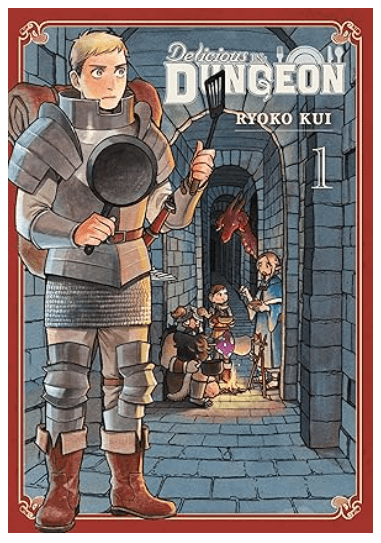
This series is based on the Manga of the same name also known as Dungeon Meshi (ダンジョン飯), written and inked by Ryoko Kui. Kimiko Ueno wrote the anime, and the animation was done by Studio Trigger. The first manga chapter was released in February 2014, with the first collected volume released on January 15th 2015. It was on the 5th of January 2024 when the first episode was aired, eventually scoring a whopping 100% on Rotten Tomatoes with a Popcornmetre score of 98%, also receiving praise from fans on IMDb for its solid character arcs and attention to detail regarding the dungeon’s ecosystem – something I loved very much.
The story is simple: what’s left of a fantasy adventuring party return to the dungeon they just barely escaped, to rescue their fallen comrade who was eaten by a dragon. However, there’s one snag – they’re flat broke and such a quest requires supplies. Though Laois, the leader of the party and brother to Falin, has a mad plan to feed them on this crawl … dungeon food. Which is, when luck would have it, they meet Senshi a master dungeon chef who is quite familiar with meals like basilisk stew, slime jellies, walking mushroom hotpot, and exorcism sorbet.
Delicious in Dungeon may seem slow at first to a western audience, especially with the show’s fixation around food. However, having lived in and toured Asia extensively, it became apparent to me that food culture and its importance in society is quite different to how we see food in the west. I am speaking from my own British perspective of course, yet after living in China and travelling Asia hitting places like South Korea, Thailand, Vietnam, Taiwan, and Japan, I felt that food was more of a big deal in these cultures compared to my own. The sourcing of ingredients, the preparing, the cooking, and the sharing. This is evidenced by the vast abundance and varieties of places to eat out and the way people talk about where they come from, and the cuisine specifically linked to their region or town. Personally, a pride and energy I feel a lot of us may have lost in the west, at least when compared to other countries and cultures.
Another aspect of the show that might seem slow is the pace and focus of the action. If you are accustomed to combat and adventure action in your fantasy, then the focus isn’t solely there. It exists, and does indeed ramp up as the series progresses, yet it is clear the “action” here is cooking. It’s more aimed at enjoying the ritual of cooking: knowing where your food comes from and what’s actually in it, and what effort went into it. Again, something I feel we may be losing or have lost in these modern times. Or at least, not something we think about all that often. It’s not only about sharing a meal with friends, but preparing it together. Again, something you feel invited to do a lot more when in Asia, where there seem to be far more restaurants centred around getting involved in the cooking of your own food, like Chinese hot pot, Korean BBQ, or Yakiniku or Sukiyaki in Japan.
Watching Delicious in Dungeon warmed my heart and did so for one reason. Nostalgia for all those experiences I had while living and travelling in Asia, and any other special meal I’ve enjoyed with friends and family. Not to mention the nostalgia for all the Dungeons and Dragons games of the past. There is a lovely festive aspect to the show that leaves you feeling warm and cosy – and there it is, cosy. For a predominant number of episodes, the atmosphere is a cosy fantasy experience of exploring food and friendship with plenty of low-stakes drama.
However, there are darker elements to the show raising questions of ethics and morals in regard to life and the giving and taking of, along with a good helping of eco-fantasy as well when considering the environment of the dungeon. This chimed with me instantly as it is a theme that holds significant importance in my own writing. Monsters are not simply there to be killed to hike up your XP or make the heroes look good. They are part of the ecosystem of the fantasy world. Slaying a dragon has an impact as much as harvesting a walking mushroom for its feet. Yet the delivery is smooth and subtle like a good dungeon dashi, which helps it resonate even more.
What caps the whole show is the sublime soundtrack scored by Yasunori Mitsuda (Chrono Trigger), who was the main Composer and Arranger for Delicious in Dungeon. The soundtrack gives me those ‘80s fantasy movie vibes. You know the ones: Conan the Barbarian, Dragon Slayer, Beast Master. At least, if you kinda squished them altogether with the music from Zelda.
What you get in the end is an anime with a whole lot of heart and soul. Something to get comfy for and snuggle up with. Perhaps with a good bowl of ramen and some friends. It’s the hug of reassurance and the comfort blanket you need after yet another one-of-those-days. And good news … they are making a season two expected in 2026.


Leave a Reply